
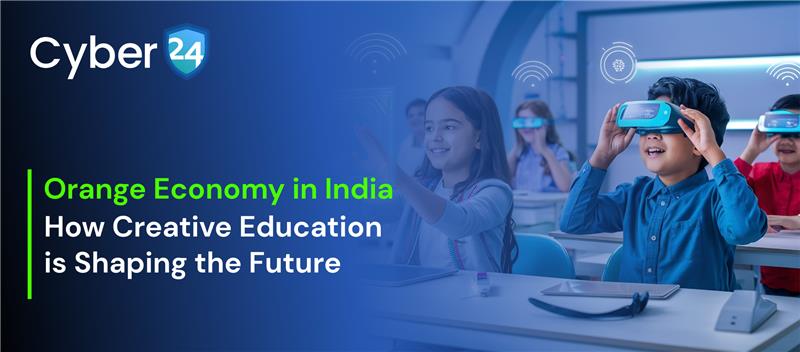
India’s education system is going through one of its most important transitions in decades. Learning is no longer limited to textbooks, classrooms, and traditional career paths. A new economic and educational movement is shaping the future — the Orange Economy.
The Orange Economy represents industries driven by creativity, innovation, intellectual property, and digital skills. It includes fields such as animation, gaming, visual effects, design, digital media, content creation, AR/VR, and emerging creative technologies. These are no longer “alternative careers” — they are becoming mainstream professions with global relevance and demand. Recognizing this shift, the Indian government is actively pushing education and policy frameworks towards creative fields.
This shift is changing not just policy and curriculum, but how parents choose schools, how students choose careers, and how institutions define relevance. Parents are moving beyond marks and rankings towards schools having ability to prepare students for the future economy. Creative curriculum, digital capability, infrastructure, and career readiness are becoming core decision factors.
The Scale of the Opportunity: Numbers That Matter
This transformation is not just a vision — it is backed by serious national investment and long-term planning.
The government has announced a ₹250 crore investment towards initiatives linked to the creative economy. At the same time, projections indicate the need for 2 million creative professionals by 2030, clearly signaling the scale of workforce demand in the coming years.
A major driver of this growth is the AVCG industry (Animation, Visual Effects, Comics and Gaming). This sector is expanding rapidly due to:
- Growth of OTT platforms and digital content
- Rise of gaming startups and studios
- Demand for AR/VR in education and training
- Expansion of digital marketing and media
- Global outsourcing of creative services to India
Today, industries are actively hiring professionals such as animators, game designers, UI/UX designers, 3D artists, VFX professionals, AR/VR developers, content engineers, and creative technologists. These roles are becoming core employment opportunities, not niche options.
This clearly shows that the future job market will not be driven only by engineering, management, or traditional professions — it will be driven equally by creative and digital careers.
What This Means for Schools and Colleges
The impact of the Orange Economy is now directly reaching educational institutions.
The government has announced the creation of National Creator Labs across the country, covering 15,000 schools and 500 colleges. These labs are designed to give students early exposure to creative technologies, digital tools, and innovation-based learning environments.
This reflects a deeper shift in education philosophy.
| Learning is moving away from: | Moving towards: |
| Rote memorization Exam-centric models Degree-focused outcomes | Skill development Creative thinking Industry alignment Employability Innovation-driven education |
Schools are no longer just academic institutions — they are becoming career incubators.
Curriculum structures are gradually shifting to include:
- Creative education
- Job-focused skill learning
- Digital literacy
- Technology-based subjects
- Industry-relevant training
In simple terms, education is no longer just about “what students know” — it is about what students can do.
A New Decision Driver: How Parents Choose Schools
This transformation is changing the education policy but more importantly it will change behaviour, decision-making, and expectations of parents and students.
Parents will no longer evaluate schools only on academics, rankings, and exam results. Increasingly, they will look for:
- Schools aligned with the government’s vision of the Orange Economy
- Curriculum that supports creative education and digital skills
- Institutions with infrastructure for creator labs, digital learning, and innovation platforms
- Schools that offer real career pathways, not just degrees
This will fundamentally change how parents choose schools for their children. Future-focused parents will actively prefer institutions that provide:
- Creative labs
- Digital learning environments
- Industry-aligned skill programs
- Innovation-driven education models
Schools with the right infrastructure and vision will gain trust, preference, and long-term brand value.
Institutions without creative infrastructure and future-ready learning environments will struggle to attract talent, while future-ready institutions will become magnets for ambition, innovation, and opportunity.
Are Schools Ready? The Reality Check.
While the vision is strong and the intent is clear, there is a real challenge on the ground — infrastructure readiness.
Creative and digital learning environments require:
- High-speed, stable internet connectivity
- GPU-powered systems for creative applications
- Cloud infrastructure
- Secure digital networks
- Scalable IT architecture
For many schools, this has become a major barrier. Building physical labs, purchasing high-end devices, maintaining hardware, upgrading systems, and managing infrastructure costs make digital transformation difficult to execute.
This creates a gap between policy vision and practical implementation.
Why Digital Transformation Is No Longer Optional
Schools that continue with traditional models risk losing relevance, competitiveness, and long-term sustainability. On the other hand, progressive schools that strategically invest in digital infrastructure and future-ready learning models gain:
- Better learning outcomes
- Higher student engagement
- Stronger parent trust
- Improved brand positioning
- Global learning standards
- Career-focused education
Future-ready schools are not defined by technology alone — they are defined by vision, adaptability, and strategic planning.
From Policy to Practice: Cyber24’s Role
What the government is pushing through policy, Cyber24 is delivering through implementation.
Cyber24 enables end-to-end digital transformation for schools — starting from the basics like dedicated internet infrastructure, to advanced services such as cloud platforms, smart classrooms, cybersecurity frameworks, and VDI Labs.
This creates a structured, scalable, and sustainable digital ecosystem for schools, allowing them to adopt innovation without heavy infrastructure burden.
Across the ecosystem, progressive institutions have already begun this shift — investing in digital infrastructure, building creative labs, and designing learning environments that move beyond theory into real-world application, creating meaningful impact on students’ lives.
With Cyber24, forward-looking schools are enabling hands-on learning experiences, giving students access to tools, platforms, and environments that earlier existed only in textbooks — now shaping real skills, real confidence, and real career outcomes.
Together, we’re building modern learning ecosystems that position schools as progressive, trusted, and future-focused — turning policy vision into practical, scalable reality.
A Practical Roadmap for Digital Transformation
A school’s digital journey should not be random. It should follow a structured roadmap and a phased approach to digital transformation:
- Build a strong digital foundation with reliable, high-speed internet
- Digitise classrooms with smart learning tools
- Enable cloud access and collaboration platforms
- Shift teaching, assignments, and assessments to digital systems
- Automate operations and administration
- Secure data, networks, and digital assets
- Train teachers and students in digital tools
- Integrate innovation platforms for continuous growth
The goal is not technology adoption — the goal is future readiness.
VDI Labs: A Direct Enabler of the Orange Economy
VDI Labs (Virtual Desktop Infrastructure Labs) play a critical role in enabling creative education without infrastructure burden.
Through a single sign-on system, students can access high-end creative applications from any device, at any location, at any time.
- Creative Learning Without Physical Labs: A school does not need to build a dedicated animation or design lab. Students can access software like design tools, animation platforms, editing suites, and creative applications virtually through VDI. With direct peering to major learning applications via Cyber24’s data centre, schools get smooth performance, low latency, and reliable access
- Equal Access for All Students: Students using normal laptops, tablets, or low-cost devices get access to high-performance applications via the cloud. Learning becomes equal, not device dependent.
- Remote Learning and Flexibility: Students can learn from school, home, or any location without scheduling constraints. Learning becomes continuous, not limited to lab hours.
- Multi-Student Learning at Scale: Multiple students can access the same applications simultaneously without performance issues, enabling collaborative learning.
- Agile Software Deployment and Curriculum Flexibility: Schools can quickly add, update, or change learning applications based on curriculum needs without hardware upgrades or complex installations. This allows institutions to adapt learning programs easily, introduce new creative tools, and evolve their digital curriculum without disruption.
Strategic Benefits for Schools:
- Eliminates the need for high-end hardware investments
- Removes the requirement to build physical creative labs
- Reduces infrastructure maintenance and operational burden
- Simplifies software deployment with zero installation complexity
- Enables centralised system management and control
- Ensures secure, protected digital learning environments
- Supports scalable, growth-ready learning models
- Builds a future-ready digital learning infrastructure
In simple terms:
High-end learning becomes possible without high-end infrastructure.
The Bigger Picture
The Orange Economy is not a future concept, it is already here. Progressive schools have already started building on this shift. They are investing in creative education, modern curriculum models, digital transformation, and future-ready infrastructure
Schools aligned with modern learning models, creative labs, and digital ecosystems are gaining trust, visibility, and competitive advantage in the education market and will be preferred choices of parents for their kids.
Schools that adapt today will shape the professionals of tomorrow. Institutions that embrace digital transformation, creative learning, and innovation ecosystems will remain relevant and will lead the future of education in India.
The future belongs to schools who prepare students for the world they will live and work in.